
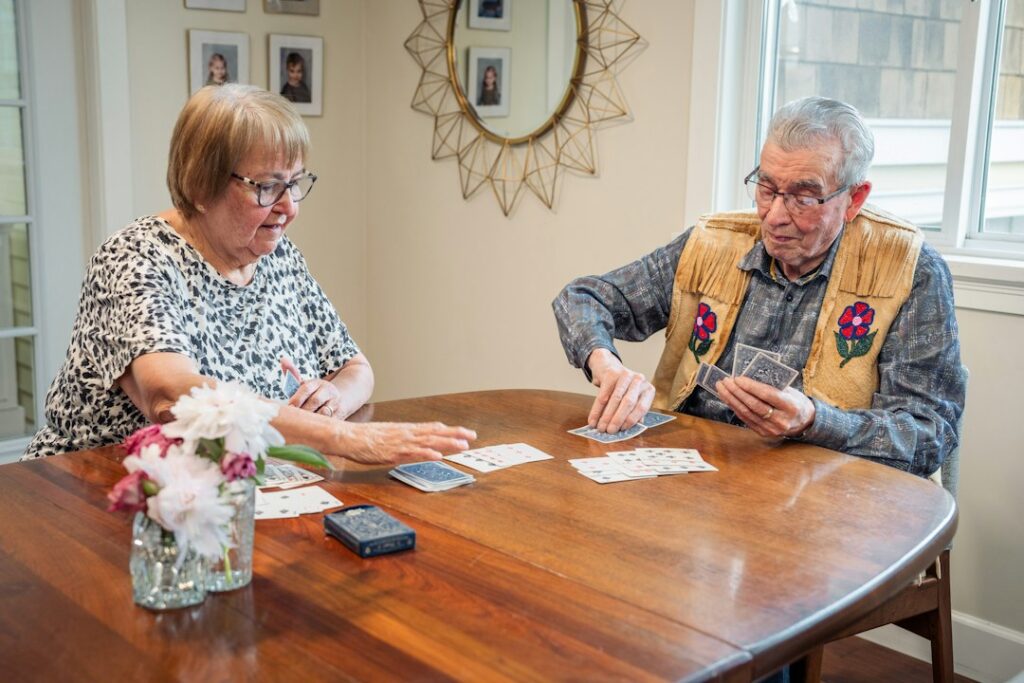
Why do games and pastimes matter in assisted living?
Games and pastimes give assisted living residents meaningful ways to use their time, connect with others, and maintain familiar routines. Activities can support conversation, memory, hand coordination, confidence, and enjoyment without feeling like formal therapy.
A good activity is not necessarily difficult or competitive. Many residents prefer pastimes that are familiar, flexible, and easy to join for a few minutes or a full afternoon. The most successful programs make room for different abilities, interests, energy levels, and personal histories.
In Emmaus, PA, seasonal weather can also shape indoor activity choices. Cold winter days, summer heat, and rainy periods may lead residents to spend more time in shared indoor spaces, where games, crafts, music, and conversation help create a comfortable daily rhythm.
What are the most popular games in assisted living?
The most popular games are usually easy to understand, adaptable, and familiar from earlier stages of life. Residents often enjoy activities that encourage social interaction without placing too much pressure on speed or memory.
Common favorites include:
- Bingo, especially with larger cards and easy-to-see markers
- Large-print crossword puzzles and word searches
- Dominoes and simple card games
- Checkers, chess, and other tabletop games
- Trivia based on music, history, television, sports, or local traditions
- Picture-matching games and reminiscence games
- Jigsaw puzzles with larger pieces
- Dice games that use simple scoring
- “Name that tune” activities
- Group quizzes played as teams rather than individual competitions
Bingo remains popular because the rules are familiar and the game can be adjusted for hearing, vision, and mobility needs. Trivia can also be modified so that residents may answer aloud, work with a partner, or simply enjoy listening.
Some residents enjoy competition, while others prefer cooperative games. A team format often makes participation easier for people who feel uncomfortable being singled out or who need more time to respond.
Which activities are best for residents with memory loss?
Residents with memory loss often benefit from activities that rely on recognition, sensory enjoyment, and long-established habits rather than requiring new information to be memorized. Familiar tasks can feel reassuring and may support conversation.
Helpful choices may include:
- Sorting buttons, cards, fabric squares, or large objects by color or shape
- Looking through photo albums and discussing familiar subjects
- Folding towels or matching socks
- Listening to favorite songs and tapping along
- Simple baking demonstrations or no-cook food preparation
- Painting, coloring, or placing stickers
- Completing familiar sayings, songs, or nursery rhymes
- Arranging flowers or caring for safe indoor plants
- Using large-piece puzzles with recognizable pictures
The goal is participation, not perfect performance. Correcting a resident repeatedly can reduce confidence. It is usually more helpful to offer gentle prompts, celebrate effort, and change the activity if frustration develops.
A familiar pastime may also be adapted to match a person’s life history. Someone who worked with tools may enjoy sorting hardware-like objects, while a former homemaker may prefer folding, arranging, or recipe-related activities. These connections can make an activity feel personal rather than childish.
Are arts and crafts suitable for older adults?
Arts and crafts can be suitable for many older adults when materials are adapted for comfort, vision, hand strength, and attention span. Creative activities do not need to produce a polished result. The process itself can provide focus and satisfaction.
Popular options include watercolor painting, seasonal decorations, greeting cards, collage, knitting, simple sewing, clay work, and adult coloring. Large-handled brushes, easy-grip scissors, thick pencils, and nonslip materials can make participation more comfortable.
Craft activities should account for possible limitations. Small beads may be difficult for residents with reduced vision or limited finger control. Strong odors, loose materials, and hot equipment may also create safety concerns. Staff or family members can help prepare supplies and keep the work area uncluttered.
Seasonal projects often work well because they give residents a reason to decorate common areas or make items for family members. Winter paper crafts, spring flower arrangements, and autumn-colored artwork can reflect the changing year without requiring residents to spend extended time outdoors.
What pastimes encourage conversation and friendship?

Group activities that provide a natural topic of conversation are often more comfortable than simply asking residents to socialize. Shared tasks reduce pressure and help people meet others with similar interests.
Conversation-friendly pastimes include music listening, current-events discussions presented in accessible language, cooking conversations, pet visits where permitted, storytelling groups, and discussions about childhood games or family traditions.
A “show and tell” format can also work well. Residents might bring or describe a meaningful object, favorite recipe, military memento, craft, photograph, or book. Participation should remain optional, since some people prefer listening to speaking.
Games can support friendships by creating repeated opportunities to sit with the same group. A resident who is hesitant during a first activity may become more comfortable after seeing familiar faces over several weeks.
How can activities be adapted for vision, hearing, or mobility changes?
Activities are more inclusive when the environment is adjusted before the game begins. Good adaptations often make the difference between a resident watching from the side and taking part independently.
Useful adjustments include:
- Providing large-print instructions and high-contrast game pieces
- Using microphones or speaking clearly while facing the group
- Reducing background noise during discussions
- Offering tables at a comfortable height for wheelchairs or walkers
- Choosing lightweight materials that are easy to handle
- Allowing extra time for turns and responses
- Offering seated versions of movement activities
- Placing supplies within easy reach
- Using tactile or textured materials when appropriate
Lighting matters as well. Glare can make cards and puzzle pieces difficult to see, while dim rooms may increase fall risk. Clear walkways and stable chairs help residents move safely around activity areas.
Residents should not be excluded simply because they cannot participate in the standard version of a game. A person who cannot hold cards may still choose answers, keep score with assistance, or contribute conversation.
Do assisted living activities need to be competitive?
No. Competition is optional, and many residents prefer activities focused on cooperation, creativity, or conversation. A competitive format can be enjoyable for some people but stressful for others.
Cooperative games allow participants to work toward a shared goal. Examples include completing a group puzzle, answering trivia as teams, creating a mural, assembling a seasonal display, or building a shared playlist of favorite songs.
Even competitive games can be made gentler by emphasizing participation instead of winning. Small changes—such as allowing hints, avoiding elimination, and recognizing creative answers—can help residents remain engaged.
How can family members support meaningful pastimes?
Family members can support activities by learning what a resident enjoyed earlier in life and sharing that information with activity staff or loved ones. Specific details are more useful than general labels. “Enjoyed gardening” might lead to plant care, flower arranging, seed discussions, or garden-themed puzzles.
Families can also bring large-print books, photographs, familiar music, simple craft materials, or a favorite card game, provided the items are safe and easy to use. Visiting during an activity may help a resident participate, but the visit does not need to become a lesson or test.
The most meaningful pastime is often one that respects the resident’s preferences. Some people want lively group games, while others prefer quiet puzzles, reading, music, bird-watching from a window, or conversation with one other person. Assisted living activities work best when they offer choice, preserve dignity, and make room for changing interests from day to day.
